

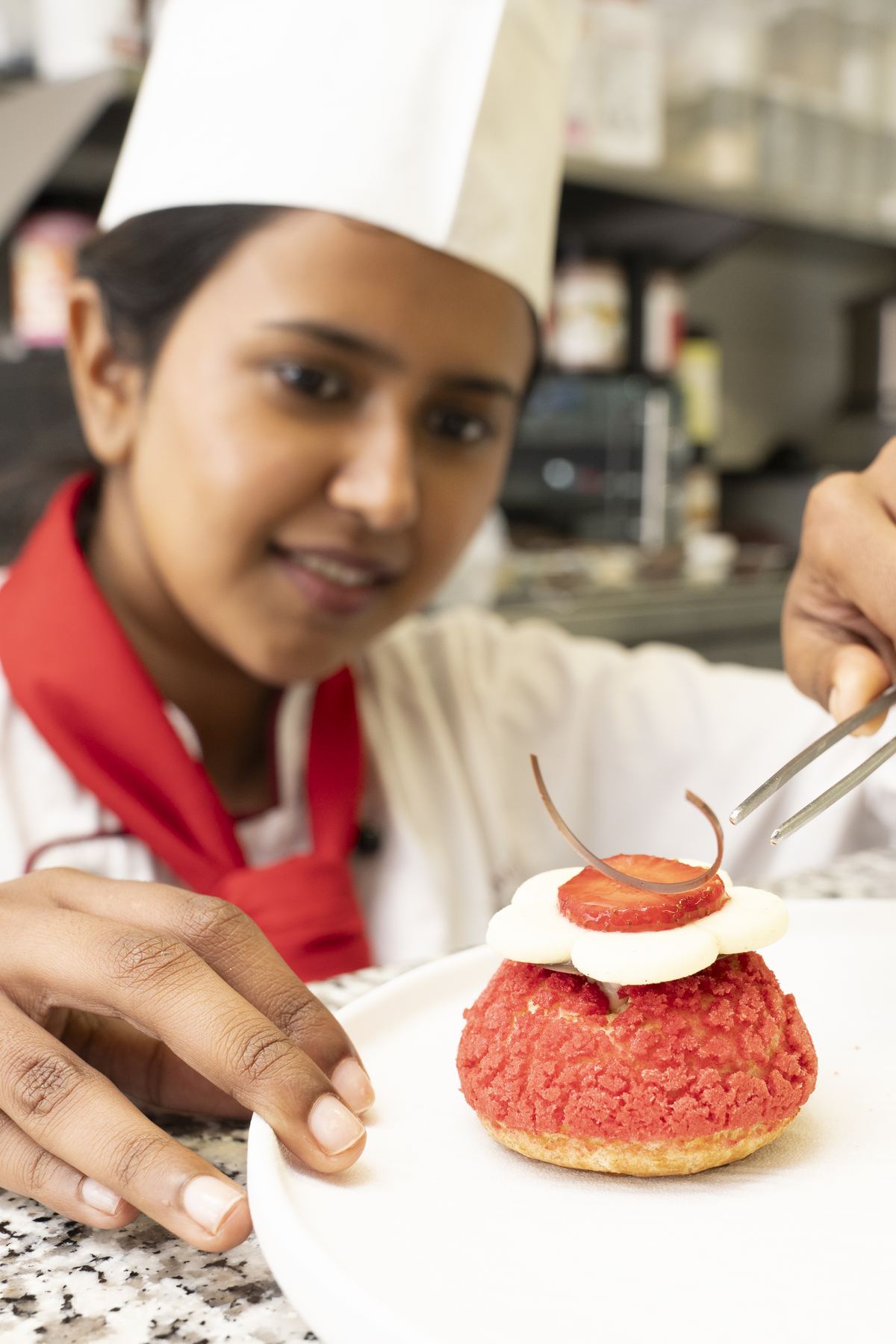
To become a pastry chef you learn the craft through a pastry school, an apprenticeship or on-the-job training (one to three years), work as a pastry cook to build speed and range, then move up to pastry sous chef and pastry chef. Leading a kitchen typically takes five years or more of experience.
No route is the "right" one. They trade money against time and structure. Here's how they compare, what the job actually is, and where the certifications fit in.
What does a pastry chef do?
A pastry chef runs the sweet side of a kitchen: breads and viennoiserie in the morning, plated desserts during service, cakes, petits fours and chocolate work for events. In a hotel or large restaurant that means a team, ordering, costing and menus. In a small bakery it can mean doing all of it yourself before sunrise. Either way it's precise, physical work with early starts and weekend shifts.
The career ladder usually runs commis or pastry cook, then demi chef or chef de partie, pastry sous chef, and finally pastry chef or executive pastry chef. Some go on to open a bakery, a chocolate shop or a business supplying hotels.
Three routes into a pastry kitchen
| Route | Typical length | Cost | Best for |
|---|---|---|---|
| Pastry school (certificate, diploma, degree) | 10 weeks to 3 years | You pay fees; some programmes include paid internships | Structured training, international jobs, career changers |
| Apprenticeship | 3 years in Switzerland (EFZ); 1–2 years for UK chef apprenticeships | You earn a (low) wage while training | School leavers who want to stay in one country |
| On the job | Up to a year to learn the basics, per the BLS for bakers | You earn from day one | People already working in a bakery or kitchen |
1. Pastry school
School gives you the whole repertoire in a set order, which is hard to get in a busy kitchen where you might pipe the same éclair for a year. Lengths vary a lot: short certificates of around ten weeks, one-year diplomas, and bachelor's degrees in pastry or baking arts. Look at three things before the brochure photos: kitchen hours, whether real work placements are built in, and what qualification you hold at the end.
At BHMS in Lucerne, as an example, the 10-week Certificate in Pastry, Chocolate and Bakery gives 180 kitchen hours for CHF 23'025 (about US$27,900 at the October 2026 rate). The one-year Diploma gives 330 kitchen hours plus a six-month paid internship for CHF 40'200 (about US$48,600), and the full path continues to the BA in Culinary Arts and Patisserie.
2. Apprenticeship
In Switzerland the classic route is the three-year apprenticeship as a baker-pastry cook-confectioner (Bäcker/in-Konditor/in-Confiseur/in EFZ), with one day a week at vocational school and two specialisations: bakery and pastry, or pastry and confectionery. Above it sit the federal professional exam (Berufsprüfung) and the higher professional exam for running a bakery-confectionery. It's an excellent system, taught in the local language and built for people who live in Switzerland.
The UK has a pastry chef apprenticeship standard, and the National Careers Service puts chef apprenticeships at one to two years. In the US, the BLS notes that apprenticeships combine classroom teaching with paid kitchen work.
3. Learning on the job
You can start as a kitchen assistant or junior baker and learn from the people around you. The BLS says most bakers learn on the job, which can take up to a year, and that no formal credential is required to start. The upside is income from day one. The downside is that what you learn depends entirely on where you land.
Skills a pastry chef needs
- Precision. Pastry is weighed to the gram and timed to the minute.
- The core techniques: doughs and laminating, creams and custards, sponges, sugar work, chocolate tempering, plating.
- Stamina. Long hours on your feet, early starts, hot ovens.
- Food safety and costing. Sooner or later you'll be responsible for a budget and a hygiene inspection.
- Creativity with discipline. New desserts, made identically two hundred times.
Certifications that count
In the US, the American Culinary Federation runs a pastry certification ladder. Each step combines education, years of experience and written and practical exams:
- Certified Fundamentals Pastry Cook (CFPC): basic knowledge, no commercial experience needed.
- Certified Pastry Culinarian (CPC): for example a one-year culinary certificate plus one year of experience, or an associate degree.
- Certified Working Pastry Chef (CWPC): several years of pastry experience, including supervising staff.
- Certified Executive Pastry Chef (CEPC): five years running pastry production.
BHMS describes its Swiss Diploma in Pastry, Chocolate and Bakery as accredited by the American Culinary Federation. In Switzerland, the qualification decides the wage category in hotels and restaurants: a three-year apprenticeship (EFZ) sets a minimum of CHF 4,528 a month in 2026, the federal professional exam CHF 5,293.
How much do pastry chefs earn?
In the US, bakers had a median of $37,160 a year and chefs and head cooks $62,470 in May 2025. In Swiss hotels and restaurants the minimum for a trained pastry cook is CHF 4,528 a month, 13 times a year. The full breakdown, with percentiles and the best-paying sectors, is in our pastry chef salary guide.
A realistic timeline
- Year 0–1: training (a certificate, the first year of a diploma, or the start of an apprenticeship).
- Years 1–3: pastry cook. You get fast, consistent and trusted with more of the menu.
- Years 3–5: chef de partie or pastry sous chef, running a section and training juniors.
- Year 5 and on: pastry chef or executive pastry chef, or your own business.
A programme with paid internships folds part of that kitchen experience into the training. At BHMS each year-long programme includes six months of paid work, at least CHF 2'390 a month gross in Switzerland, so a bachelor's graduate leaves with eighteen months in professional kitchens. More on that on our sister site's careers page and the school's pastry programmes on bhms.ch.
Not sure yet which level suits you? The 2-minute fit check gives an honest answer, or compare all pastry programmes side by side.