

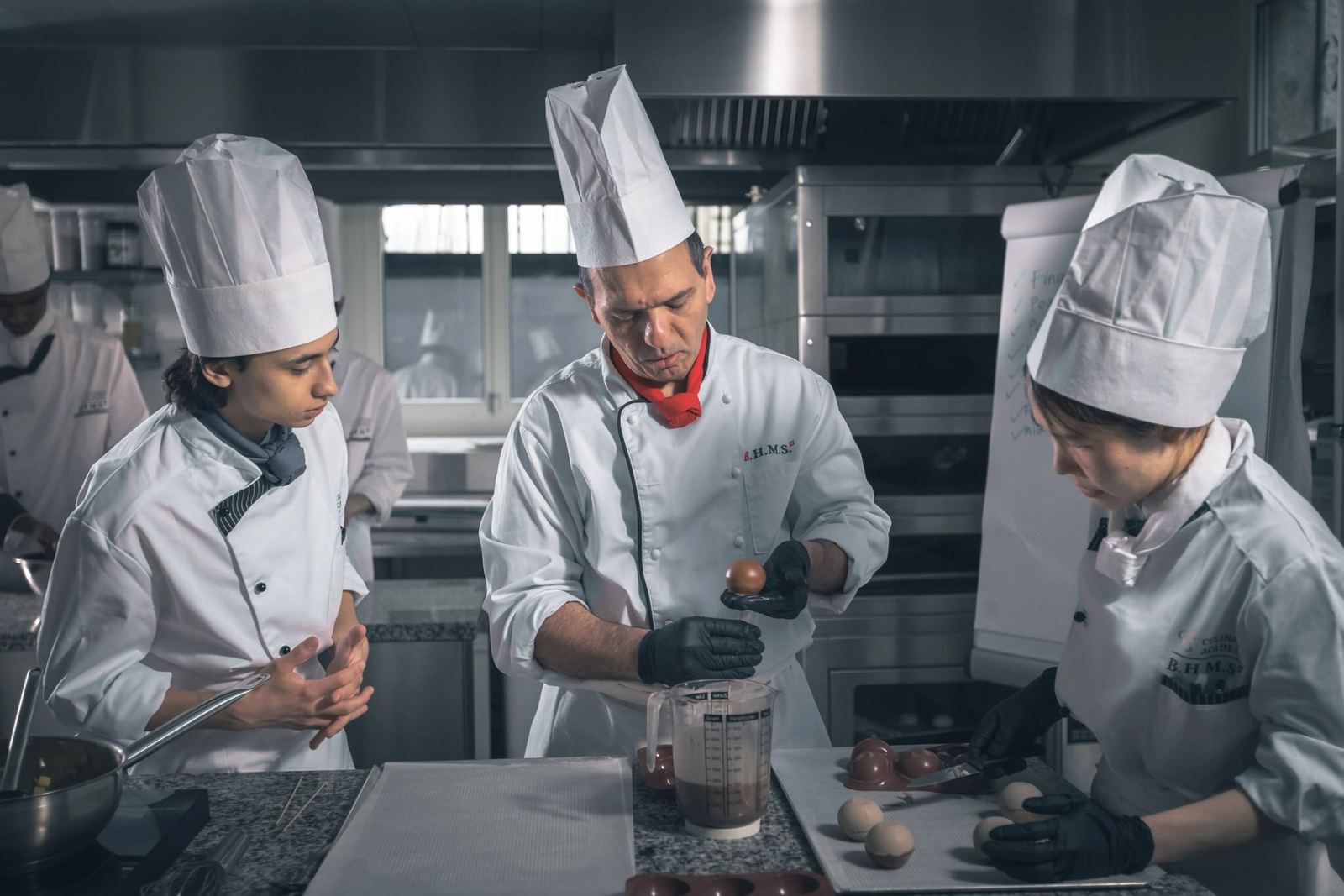
Swiss chocolate is famous for two inventions made in the 1870s: milk chocolate, created by Daniel Peter in Vevey in 1875, and conching, developed by Rodolphe Lindt in Bern in 1879, which made chocolate smooth enough to melt on the tongue. Today Swiss producers sell 71.1% of their chocolate abroad, and the Swiss themselves eat about 10.3 kg each a year.
That's the short version. The longer one runs through a handful of family workshops on Lake Geneva and in Bern, a lot of trial and error with milk, and a set of rules that still decide which bars may carry a Swiss cross. We teach chocolate in Lucerne, so we've also added where to taste it around here, and what learning it professionally looks like.
A short history of Swiss chocolate
Chocolate first came to Switzerland, as to the rest of Europe, as a drink. What changed in the 19th century was machinery. Swiss makers were among the first to mechanise production, and from 1819 a series of small factories turned chocolate into something you could eat as a bar.
| Year | What happened |
|---|---|
| 1819 | François-Louis Cailler opens one of the first mechanised chocolate factories, in Corsier near Vevey. Cailler is the oldest Swiss chocolate brand still on sale. |
| 1826 | Philippe Suchard opens his factory in Serrières near Neuchâtel and invents the mélangeur, a machine that mixes sugar and cocoa powder. |
| 1830 | Charles-Amédée Kohler starts making chocolate in Lausanne (the Historical Dictionary of Switzerland dates the factory to 1831). |
| 1845 | David Sprüngli opens a confectionery in Zurich, the root of today’s Lindt & Sprüngli. |
| 1852 | Aquilino Maestrani starts in Lucerne, before moving to St. Gallen. |
| 1875 | Daniel Peter, Cailler’s son-in-law, works out how to combine chocolate with milk in Vevey: the first milk chocolate. |
| 1879 | Rodolphe Lindt invents conching in Bern, creating the first chocolate that melts on the tongue. |
| 1899 | Johann Rudolf Sprüngli buys Lindt’s company: Lindt & Sprüngli. In Bern, Theodor Tobler adds a chocolate factory to the family confectionery. |
| 1908 | Toblerone is launched in Bern. |
| 1911 | Peter, Cailler and Kohler merge as Peter-Cailler-Kohler, which Nestlé buys in 1929. |
Notice how close together these people were. Cailler, Peter and Kohler all worked on the shores of Lake Geneva, in Vevey and Lausanne, and two of them were family: Peter married Cailler's daughter in 1863. Lindt and Tobler were both in Bern. A small, dense group of makers, competing and borrowing from each other, is a big part of why the breakthroughs came from here.
Who invented milk chocolate?
Daniel Peter did, in 1875. He had opened his own chocolate factory in Vevey in 1867, and the problem he was trying to solve was water: milk is mostly water, chocolate hates it, and early attempts spoiled or turned grainy. Peter's answer was condensed milk. His neighbour in Vevey was the company of Henri Nestlé, which supplied it. Peter's business later merged with Cailler and Kohler as Peter-Cailler-Kohler in 1911, and Nestlé bought the group in 1929.
It's worth pausing on how much that one idea built: every pastry chef who makes a milk-chocolate mousse, ganache or bonbon today is working with Peter's invention.
What is conching, and why did it matter?
Before 1879, eating chocolate was gritty and crumbly. In his factory in Bern, Rodolphe Lindt found that slowly stirring and aerating the warm chocolate mass for a long time changed it completely. Lindt & Sprüngli describes what happens: intense shear breaks up clumps of particles, and bitter, unwanted compounds escape. The result was the first chocolate that melted in the mouth, called fondant chocolate.
Lindt's company joined David Sprüngli's Zurich business in 1899, when Johann Rudolf Sprüngli bought it. Conching, or a refining process like it, is still a standard step in chocolate making everywhere.
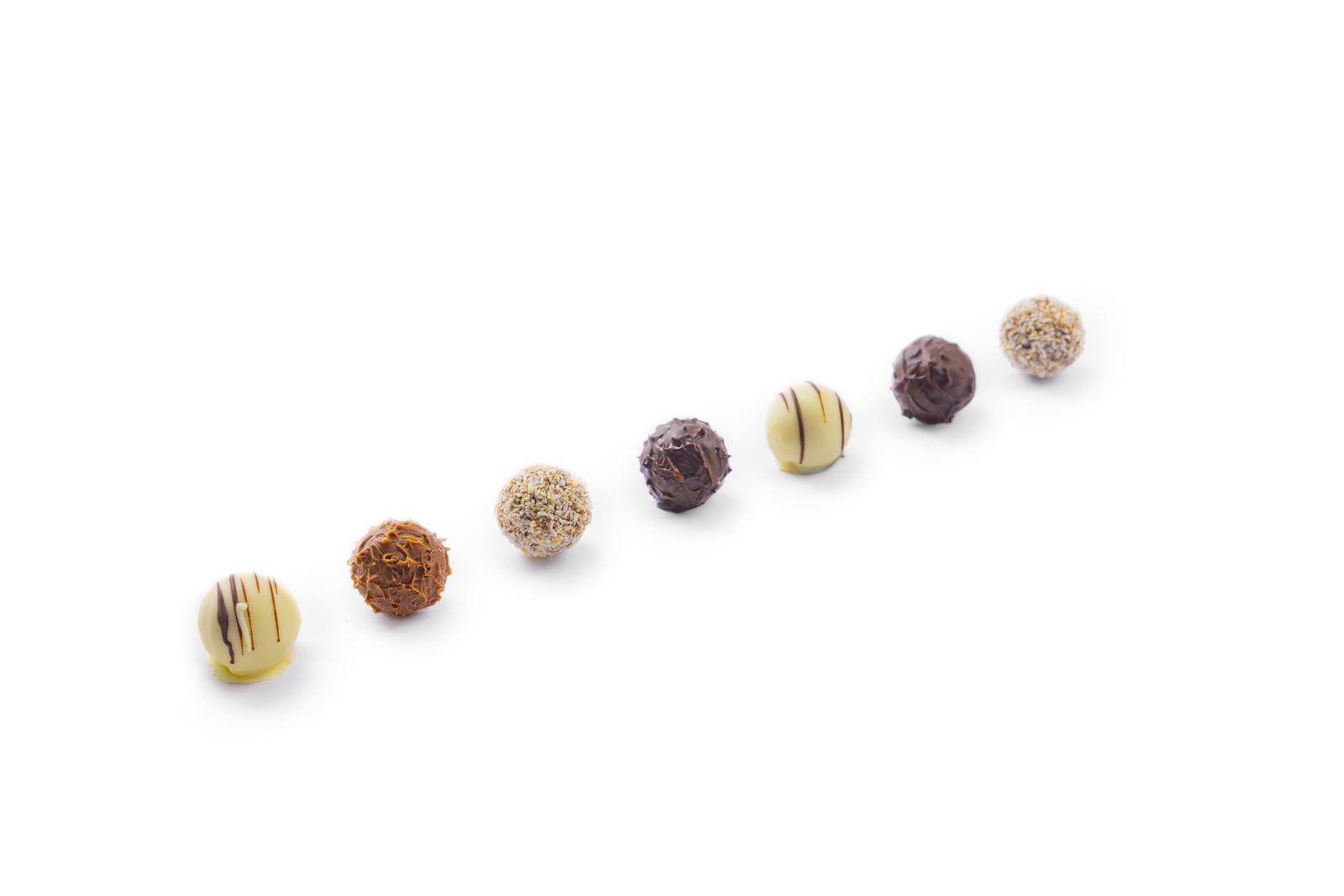
How Swiss chocolate is made today
The cocoa itself comes from the tropics. Chocosuisse, the association of Swiss chocolate manufacturers, describes the factory process in three main steps:
- Select, check and mix the ingredients. Dark chocolate starts from cocoa mass, cocoa butter and sugar. Add milk powder or condensed milk and you get milk chocolate. Leave out the cocoa mass, keep the cocoa butter, and it's white chocolate.
- Crush and refine. Rollers and mills grind the mixture into extremely fine particles. Too large and the chocolate tastes sandy; too small and it feels greasy.
- Conch. The mass is heated and stirred for hours, which gives it the creamy, melting texture. It is then formed into bars and pralines.
And in a pastry kitchen
Pastry chefs mostly start where the factory stops, with couverture: a chocolate rich in cocoa butter, made for professional work. The first skill is tempering, which means melting the chocolate, cooling it and bringing it back up to a precise working temperature so the cocoa butter sets in a stable form. Tempered chocolate snaps cleanly, shines and releases from a mould; untempered chocolate turns dull and streaky. As a rough guide, dark couverture is melted at around 45–50 °C, cooled to 27–28 °C and worked at 31–32 °C, but every maker prints its own curve on the pack, and that curve is the one to follow. Bonbons, moulded figures, decorations and showpieces all start here.
What makes chocolate “Swiss”?
Since 1 January 2017, Switzerland's Swissness rules decide who may call a food Swiss. For chocolate, three points matter:
- At least 80% of the weight of the raw materials that Switzerland can produce must come from Switzerland. For milk the figure is 100%.
- Ingredients that can't be grown in Switzerland, cocoa included, are left out of that calculation.
- The processing step that gives the product its essential character has to take place in Switzerland.
So a Swiss milk chocolate is made with Swiss milk, but never Swiss cocoa.
Swiss chocolate in numbers
| Total sales | 192,548 tonnes (−7.9% on 2024) |
|---|---|
| Exports | 136,829 tonnes, 71.1% of sales |
| Sold in Switzerland | 55,719 tonnes |
| Revenue | CHF 2.467 billion (+11.8%), about US$3 billion |
| Consumption per person | 10.3 kg, of which 6.1 kg Swiss and 4.2 kg imported |
| Main export markets | Germany, the United Kingdom, France, Canada, the United States |
| Chocosuisse members | 16 factories, 4,557 employees |
Volumes fell while revenue rose in 2025, so each tonne sold for more. Dollar figures here are approximate, at the October 2026 rate.
The names to know
- Cailler (1819, Vevey region): the oldest surviving Swiss chocolate brand, now part of Nestlé, with its visitor centre in Broc.
- Suchard (1826, Serrières): the mélangeur, and later a merger with Tobler in 1970.
- Kohler (1830/31, Lausanne): one of the early Lake Geneva makers, merged with Peter and Cailler in 1911.
- Daniel Peter (1875, Vevey): milk chocolate.
- Lindt & Sprüngli (Sprüngli 1845 in Zurich, Lindt 1879 in Bern, merged 1899): conching, and today one of the best-known premium brands.
- Tobler (Bern, Toblerone 1908): the triangular bar with honey and almond nougat.
- Maestrani (1852, Lucerne, later St. Gallen): proof that Lucerne was on the chocolate map early.
Where to taste Swiss chocolate around Lucerne
If you're in Lucerne, you don't have to go far:
- Aeschbach ChocoWelt, in Root just outside Lucerne: bean-to-bar stations, tastings and a workshop where you make your own 200 g bar. Open daily.
- Max Chocolatier, Lucerne: a family chocolatier founded in 2009, with a shop, events and workshops.
- Confiserie Bachmann, Lucerne: a confiserie since 1897, with a shop at Schwanenplatz and pastry workshops.
- Lindt Home of Chocolate, Kilchberg near Zurich: opened on 13 September 2020, with an interactive museum, a view of the pilot plant and a chocolate fountain over nine metres tall.
- Maison Cailler, Broc: the Cailler factory's visitor centre, with tastings and tempering workshops.
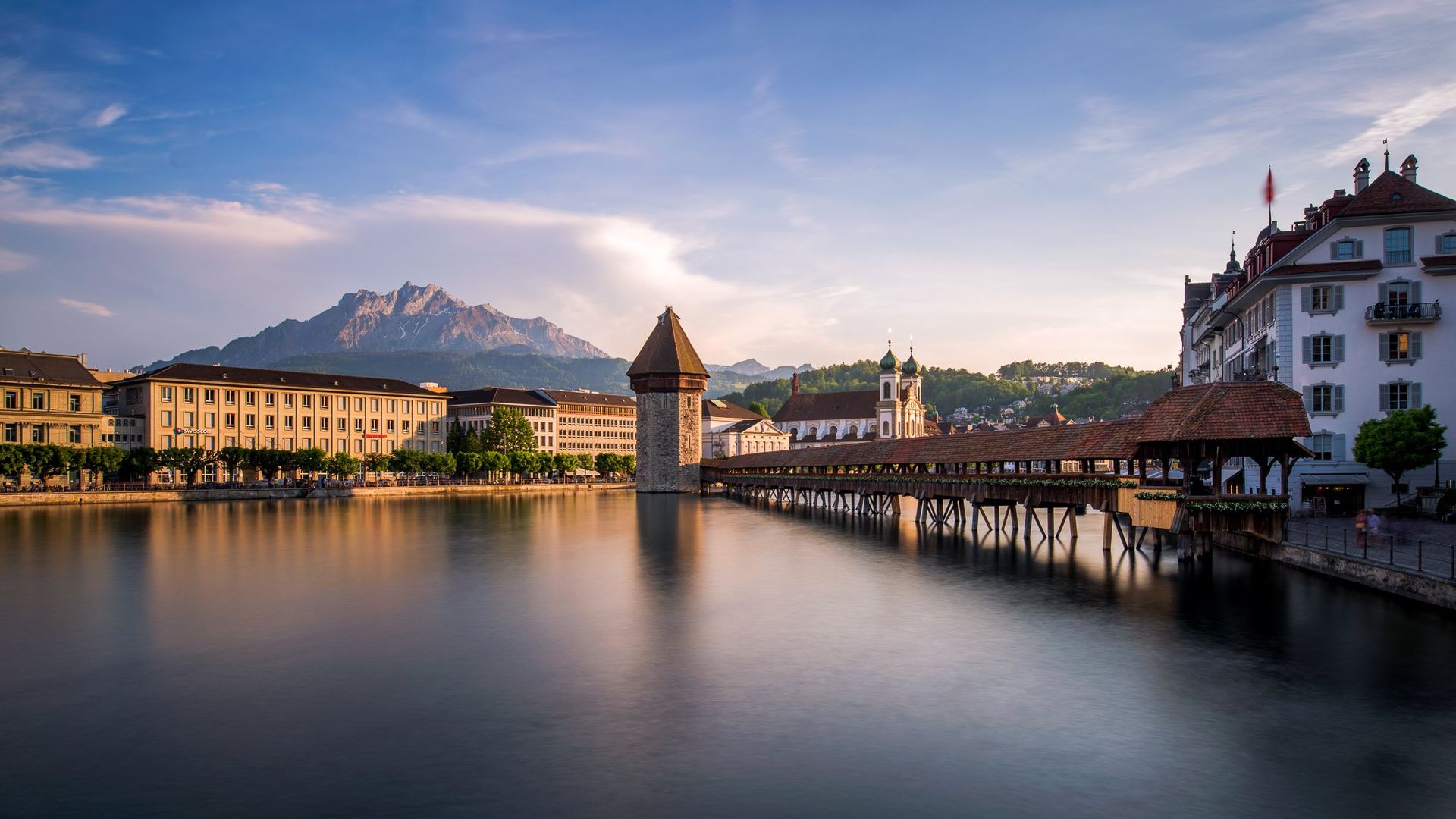
Studying chocolate in Switzerland
Tasting is one thing. If you'd like to work with chocolate, BHMS teaches it as part of every pastry programme in Lucerne, in English:
- The 10-week Certificate in Pastry, Chocolate and Bakery (CHF 23'025, about US$27,900) includes Chocolate Work Foundations; the Advanced Certificate adds Advanced Chocolate Pralines.
- The one-year Diploma in Pastry, Chocolate and Bakery (CHF 40'200, about US$48,600) teaches chocolate alongside patisserie and bread, followed by a six-month paid internship.
- The Higher Diploma goes on to advanced pralines and showpieces.
You can see the labs on our pastry and chocolate kitchens page, and the school's own overview on bhms.ch. If chocolate is where you want to end up, our guide on how to become a pastry chef maps the rest of the route.